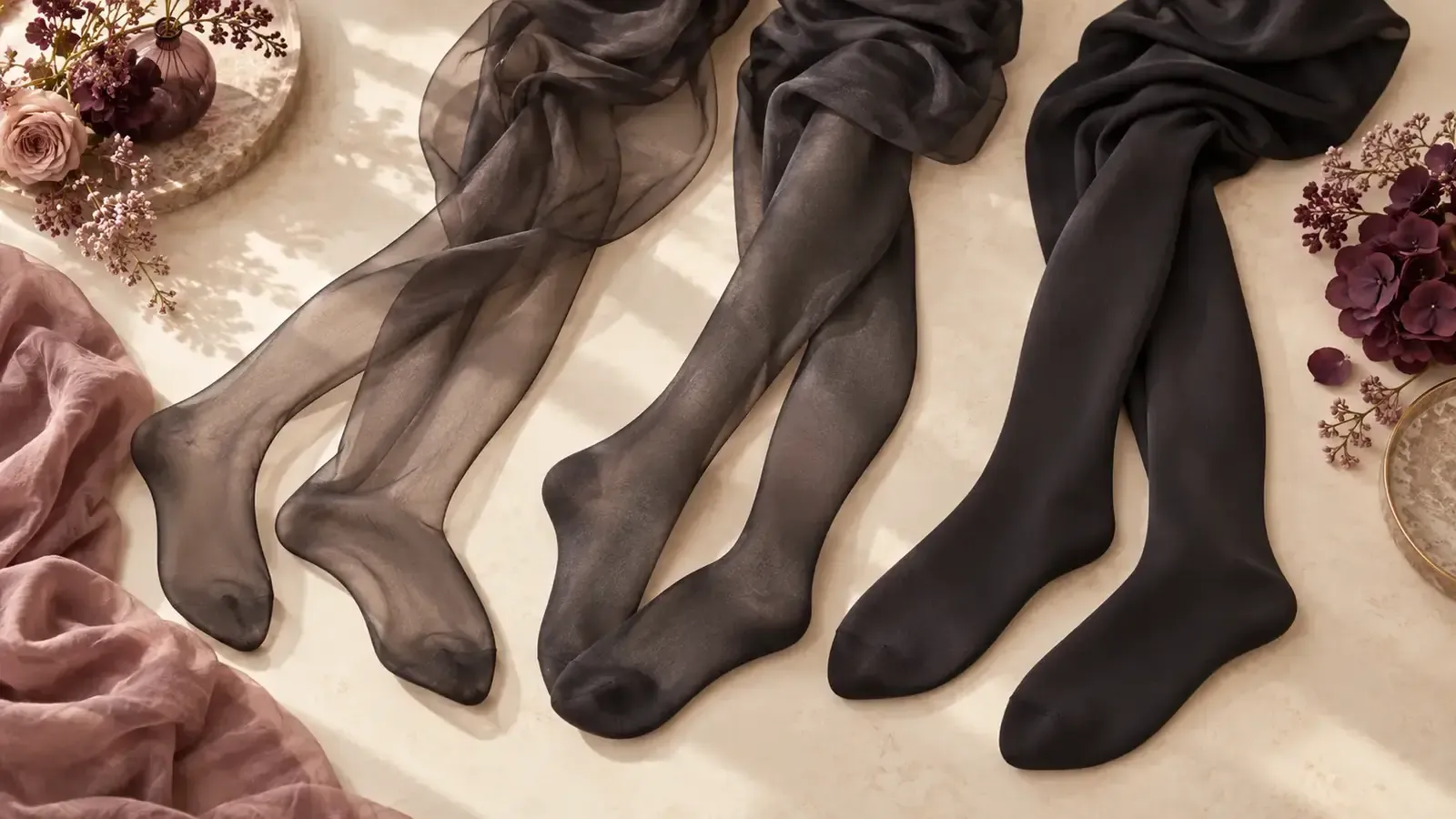
Sheer vs Opaque Tights Explained
Sheer and opaque describe how much light passes through your tights. Here is how to tell them apart and pick the right finish.

Sheer and opaque are the two ends of a spectrum, and the space between them is where most everyday tights live. Knowing where a pair sits on that spectrum — and what changes it — makes it much easier to choose the right finish for an outfit.
The spectrum at a glance
| Finish | Typical denier | What you see | Best for |
|---|---|---|---|
| Sheer | 8–30 | Skin shows through clearly | Warm weather, evening, polished work |
| Semi-sheer | 30–40 | A soft veil; some leg visible | Everyday smart, transitional weather |
| Semi-opaque | 40–60 | Mostly solid, faint shadow in light | Daytime, spring and autumn |
| Opaque | 60–100+ | Solid block of colour | Cooler weather, full coverage |
The edges between these are soft. A dark 40 denier can look almost opaque, while a pale 40 denier can look much sheerer.
What “sheer” really means
Sheer tights let the skin show through. They are fine, light and typically chosen for warmer weather or more formal occasions. Sheer hosiery generally sits between 8 and 30 denier.
A good sheer pair should look even across the leg. If you can see darker bands, pale patches or a stretched sheen, the fit is probably too small — sheer tights show every imperfection in the fit, which is why sizing matters so much with the lighter deniers.
Sheer tights come in a few common forms:
- Sheer to the waist, where the fine knit continues all the way up.
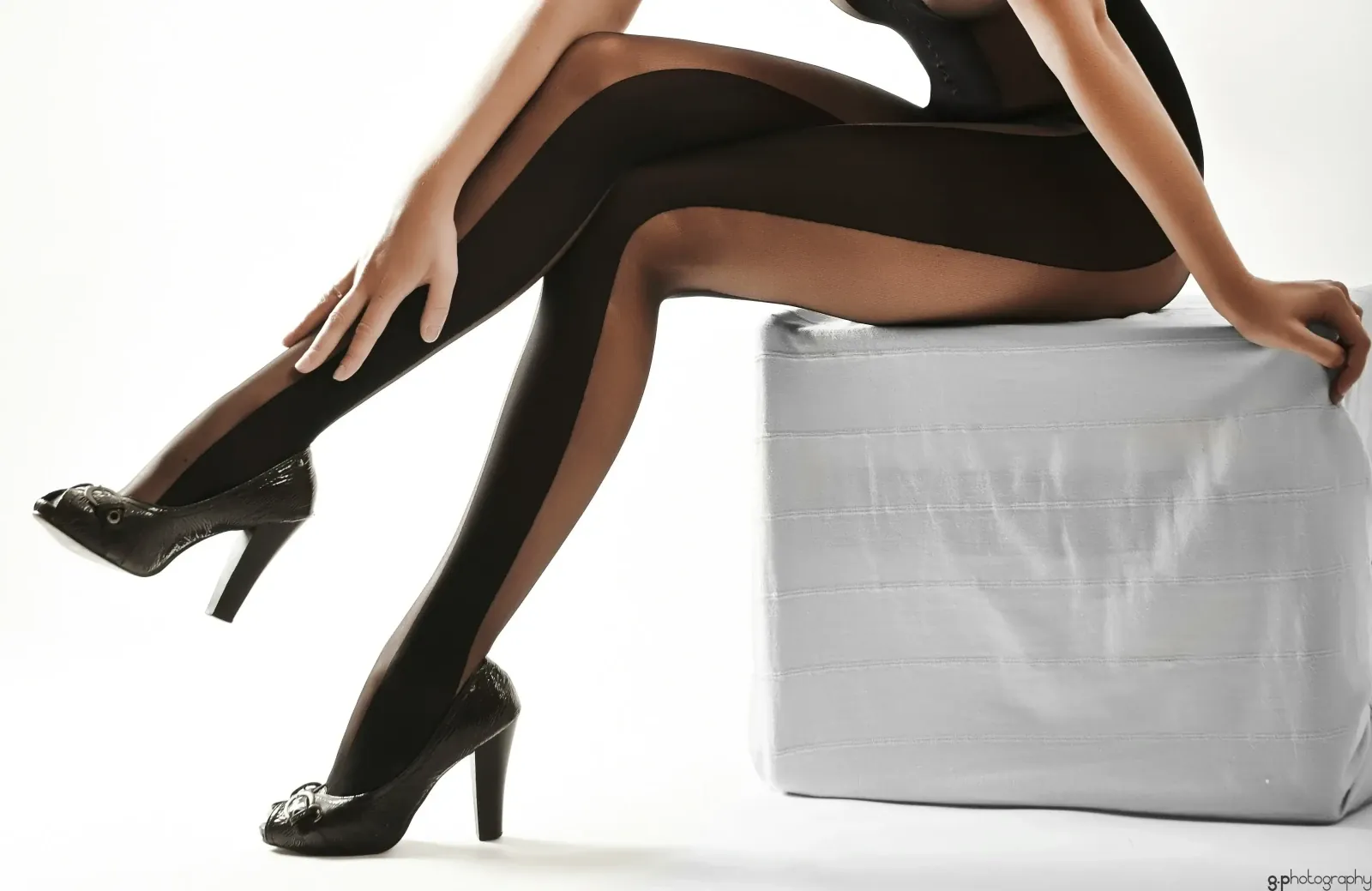
- Sheer leg with an opaque brief, which offers a bit more coverage and modesty at the hip.
- Control-top, where the brief is firmer to smooth the tummy.
What “opaque” means
Opaque tights block the leg beneath them. They are denser, usually warmer and far more forgiving of fit and skin tone. Opaque hosiery generally starts around 60 denier and goes well beyond 100.
They are the natural choice for cooler weather and for creating a clean, solid line under a skirt or dress. Because there is no skin showing through, opaque tights also let you play with colour: deep burgundy, bottle green, charcoal and navy all read beautifully when they are solid.
The middle ground
Between the two sits semi-opaque hosiery, roughly 40 to 60 denier. It offers coverage without the weight of a full opaque, which makes it one of the most useful ranges for spring and autumn — and for anyone who wants a little more than sheer without committing to a heavy winter pair.
For the difference between the sheer and opaque ends in practice, our guide to denier explains how the numbers translate into what you see.
What changes the look
Three things shift the appearance more than the denier alone:
- Colour. Black reads far more opaque than a pale shade at the same denier. Nude shades are the most see-through; deep colours the most solid.
- Finish. A matte finish looks softer and more understated. A slight sheen catches the light and can emphasise the shape of the leg, for better or worse.
- Pattern and texture. Micro-fishnets, ribs and subtle motifs change how dense the fabric appears without changing the denier. A fine rib can make a 40 denier look closer to opaque.
A quick guide by occasion
- Warm weather or evening wear: sheer, 15–20 denier.
- Everyday and work: semi-sheer to semi-opaque, 30–50 denier.
- Spring and autumn: semi-opaque, 40–60 denier.
- Cold weather and full coverage: opaque, 70 denier and up.
Styling notes
- With black: pair sheer black tights with black shoes and a black hem for the longest, cleanest line.
- With a dark skirt: opaque tights in the same colour family read as one continuous silhouette.
- With pale shoes: keep hosiery close to the leg’s natural tone, or go deliberately opaque, rather than choosing a tone in between.
- Layering: in winter, a thin sheer pair worn under a heavier opaque pair adds warmth without bulk — see the best tights for winter.
A note on care
Sheer tights are the most fragile, so treat them gently: cool water, no tumble dryer and a mesh bag in the machine. Our guide to washing tights without damaging them covers the routine in full.
Frequently asked questions
Is 40 denier sheer or opaque?
It is usually semi-opaque. In black it can read as nearly opaque; in a pale shade it looks considerably sheerer.
Are opaque tights warmer than sheer tights?
Generally yes, because the knit is denser and traps more air — but fibre matters too. A thermal or fleece-lined sheer is warmer than a plain opaque. Look for the words thermal, brushed or fleece-lined if warmth is the priority.
Can you wear sheer tights in winter?
You can, especially layered under a heavier pair or worn with boots. For real cold, an opaque or thermal pair will be far more comfortable.
What is “sheer to waist”?
It means the fine, see-through knit continues all the way to the waistband, rather than stopping at an opaque brief. Sheer-to-waist tights are popular for evening wear and warmer weather.
The short version
Sheer lets light through; opaque blocks it. Denier sets the baseline, but colour and finish decide the final look. Keep a sheer pair, a semi-opaque pair and an opaque pair to hand and you will always have the right finish. Browse more in Tights.